

If you’ve ever run a BIM team, you’ve probably had a Jackson Lamb moment. Standing there, hands in pockets, quietly wondering how you ended up responsible for this particular collection of talent, trauma, and half-documented workflows. Slow Horses dresses itself up as a spy thriller, but underneath it’s really a story about work. Badly managed organisations. People sidelined for mistakes. Teams no one quite knows what to do with. And yet, somehow, things still get done. Which makes it one of the most accurate depictions of BIM management I’ve seen on television.
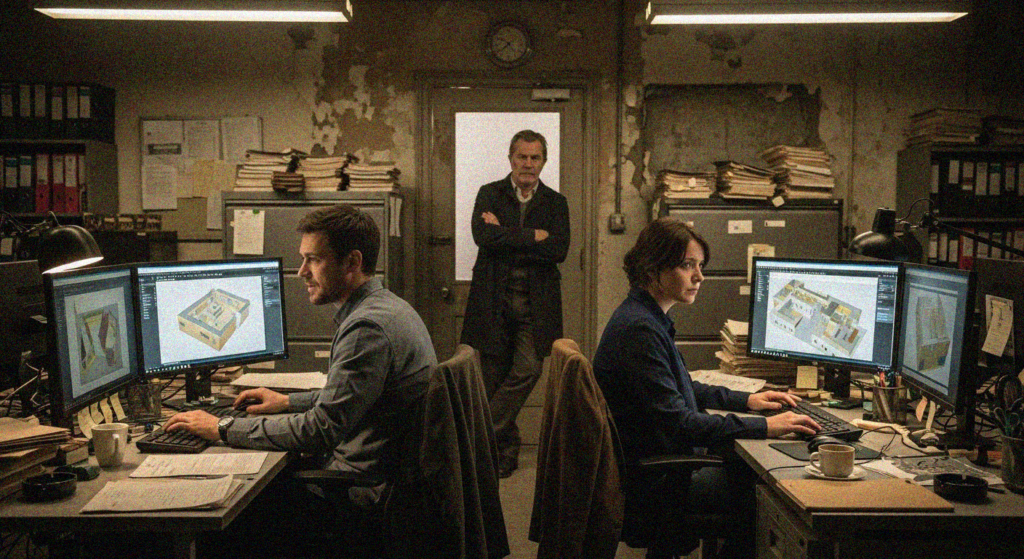
Slough House, but Make It BIM
Slough House is where MI5 sends its mistakes. Not the idiots — the awkward ones. The people who embarrassed the wrong person, questioned the wrong process, or simply didn’t fit the narrative.
Every architecture practice has its own version of this. It might be a corner of the office, a forgotten project room, or a Teams channel nobody outside digital ever opens. That’s where the BIM team lives.
Not because they’re bad at their jobs, but because they’re inconvenient. They ask questions. They remember past failures. They don’t clap enthusiastically when someone announces a “new digital vision”.
And yet, when the model collapses at 10pm before an issue deadline, that’s exactly where everyone ends up.
Jackson Lamb, Accidental BIM Manager
By any HR metric, Jackson Lamb is unemployable. He’s rude, dismissive, allergic to optimism, and openly contemptuous of management theatre.
But here’s the uncomfortable bit: he’s good at the job.
He doesn’t motivate with slogans. He doesn’t pretend everything is fine. He understands that leadership, in dysfunctional systems, is mostly about damage control. Keeping nonsense away from people who are trying to work. Letting competence exist without forcing it through a process diagram.
That’s BIM management in real life.
Most BIM managers don’t spend their days innovating. They translate. They buffer. They quietly stop bad ideas reaching fragile systems. They absorb pressure from above so the model doesn’t absorb it instead.
Lamb would fit right in.
The Team You Didn’t Order (But Got Anyway)
The beauty of Slow Horses is that none of the team should work together. They’re mismatched, bruised, occasionally insufferable. Each one is a problem in isolation.
Which makes them instantly recognisable.
Every BIM team has the disillusioned graduate who knows things could be better and is furious they aren’t. The dependable all-rounder who actually keeps things moving. The technical genius who is right far too often to be ignored. The keeper of institutional memory who remembers exactly how this went wrong last time.
They don’t form a neat org chart. They form a truce. And somehow, the work gets done.
That’s the uncomfortable truth about BIM teams. They’re rarely polished. Often cynical. Occasionally brilliant by accident. The magic isn’t in smoothing off the rough edges, it’s in letting those edges exist without cutting each other to pieces.
Too many practices chase the idea of the perfect digital team. Perfectly trained. Perfectly aligned. Perfectly documented. In reality, the teams that actually deliver are messy, opinionated, and slightly broken. They’ve seen things fail. They’ve learned workarounds the hard way. They don’t believe the hype anymore.
Why This Works (Against All Logic)
Because real digital work doesn’t happen in perfect conditions. It happens in the gaps. Between deadlines, politics, and half-understood decisions made three levels above the model.
Misfit teams work because they’ve failed already. They’ve learned where the cracks are. They don’t believe in magic fixes or software launches. They rely on judgement, experience, and a shared understanding of what actually matters when things go wrong.
Uniform teams look good in diagrams. Messy teams survive projects.
The BIM Management Nobody Puts on Slides
There’s a fantasy version of BIM leadership that lives in conference presentations. Visionary. Strategic. Clean. Full of arrows pointing optimistically upward.
Then there’s the real version. Slightly tired. Cynical. Deeply practical. Spends more time preventing disasters than announcing success.
Jackson Lamb belongs to the second category. And so do most good BIM managers, whether they admit it or not.
They don’t need applause. They need space. They need trust. And occasionally, they need to be left alone to fix things quietly before anyone notices they were broken.
Final Thoughts
If you see a bit of Jackson Lamb in your BIM manager, don’t panic. It probably means they’re doing their job.
You don’t need perfect people. You don’t need perfect processes. You just need the right collection of misfits, and someone cynical enough to keep them working.
After all, if Slough House can save MI5, there’s still hope for your federated model.